Social Media Target Strategies For A Better 2009

January 5, 2009 · View Comments

Jason Falls

Jason Falls

Jason Falls

I’ve long been of the belief that the vast majority of social media thinkers and doers easily lapse into the self-gratifying bubble that is our little online world and forgets the primary audience to which we should speak lies not on Twitter or Facebook or blogs. We are good a sharing social media. We are better at stroking each other and the latter is easier to accomplish.

But what it accomplishes is little. I’ve said before that I feel we should spend less time talking to each other and more talking to the un-enlightened. I’ve made speaking commitments for 2009 at conferences and engagements outside my comfort zone for that very reason. The Social Media Club Louisville will take a decided direction on education, offering paid boot camps for non-profits, educators, public relations professionals and more this year. We will focus on the tools, the basics and getting to know social media so that when we do have events to talk strategy, we aren’t met with deer-in-headlights looks and cricket chirping.

But what can we do for our clients, our businesses and our immediate social media needs to get outside that box as well?
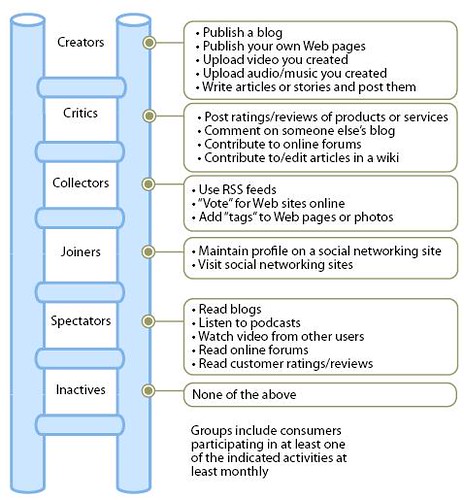
Forrester Researchs Social Technographics Ladder from Flickr.

Forrester Research's Social Technographics Ladder from Flickr.

Let’s start with Forrester’s now familiar Social Technographics Ladder. This image proposes Internet users are made up of six groups of participants: those who don’t participate in social sites; spectators who look, but nothing more; joiners who maintain profiles but don’t really get “into” it; collectors who will vote, add tags and maybe use RSS feeds but little else; critics who contribute comments, ratings, edit articles in a wiki and participate on other sites but not their own; and creators who publish their own materials.

According to Forrester’s 2008 statistics to fill in those roles, 21 percent of Internet users are now creators, up from 18 percent in 2007. Surprisingly, 25 percent are inactive, down dramatically from 44 percent in 2007. And an astonishing 69 percent are now spectators (up from 48 percent). All other categories increased as well.

Forrester Researchs Social Technographic Profile of U.S. Online Adults via Flickr

Forrester Research's Social Technographic Profile of U.S. Online Adults via Flickr

Here’s what these numbers mean to me and how they translate to actionable strategies for your 2009 social media activities.

  1. More people are adopting the social web as a regular activity.
  2. With almost 70 percent of all Internet users now watching what is happening on social sites, companies are now at a critical point in time in doing something meaningful there to capture those attentions.
  3. The traditional marketing mindset, however, seeks numbers, eyeballs, etc., so the programs developed are aimed at influencers hoping for the trickle-down and long-tail effects of “going viral.”
  4. This means the way we are approaching social media targeting is flawed.

Instead of developing programs to entice the creators or critics into talking about our companies, products or services, why don’t we develop ones that focus on the spectators and serve their needs? By giving them what they’re looking for, we connect our brand to their experience in a meaningful way. And frankly, if we do that, the creators and critics will follow.

It’s worth a shot, right?

Here’s a snippet of what I mean:

Let’s say you’re the brand manager for the Smart Car. You develop a lifestyle website around the Smart Car with content focused on green issues, other eco-friendly companies and programs, helpful tips and pointers to a green lifestyle, environmental event coverage, charity partnerships, etc. Think of it as a tree-hugger’s magazine online. (I don’t say “blog” because that’s the first word that turns most spectators — read: brand managers — off.) By giving the spectator the type of experience online they’re perhaps looking for, but also intertwining your very relevant brand into the content and messaging, you’re giving them something useful. By doing so, you enamor your brand with them and have a chance at sales, conversions, etc.

That’s just one idea and not one given a lot of thought. Imagine, Mr. or Mrs. Smart Car Brand Manager, what we could accomplish if I were fully functional, being paid and off my pain meds. (Heh.)

So my challenge to all of us in 2009 is to not stop thinking about the influencers, but start thinking about the larger audiences of people just toe-tipping the social web, too. Let’s give them something to consume, something to do, some people to interact with on behalf of the brand. Why does it have to be on an influencer’s blog? Why can’t it be on our dime, our time and our server? Let’s see what we can do to not scare them off and show them that we’ve been listening. We know you don’t want to be marketed to. We just want to welcome you to our new world where we talk, listen, share and collaborate.

If we do that, 2009 will be our best yet.

Reblog this post [with Zemanta]
Did you enjoy this blog post? If so, then why not:
Leave Comment Below | Subscribe To This Blog | Sign Up For Our Newsletter |


{ 11 trackbacks }

Social Media Targeting Strategies | Social Media Explorer | thesocialmediasecrets
January 5, 2009 at 9:31 pm
The Big List of 2009 Marketing Predictions « Itjbmarketing’s Blog
January 6, 2009 at 11:47 am
» Web Marketing: 10 predizioni per il 2009 - the big list> Search Engine Marketing e Advertising. Andrea Cappello Blog
January 8, 2009 at 4:52 am
Clinton Skakun’s Blog » Blog Archive » Targeting The Spectators(of Social Media)
January 10, 2009 at 7:17 pm
The Big List of 2009 Marketing Predictions « James Ketchell
February 5, 2009 at 2:51 am
Ryan Stephens Marketing » 21 Essential Blog Posts from Janurary ‘09
April 26, 2009 at 11:55 pm
Fastspot Blog » Twitter for Non-Profits
June 4, 2009 at 2:53 pm
» Top 40 + 200 Blog Posts on Social Media Spotlight Ideas
November 9, 2009 at 6:19 pm
» Top 250 Blog Posts – Advertising, Marketing, Branding, Digital Spotlight Ideas
November 10, 2009 at 6:38 pm
Top 250 Blog Posts – Advertising, Marketing, Branding, Digital | Advertising News
November 10, 2009 at 7:58 pm
Twitter for Non-Profits
January 8, 2010 at 4:00 pm

{ 208 comments… read them below or add one }

Peter January 13, 2009 at 12:54 pm

Jason – couldn't agree more. I was pleasantly surprised looking at the technographics that the audience is there from a spectator perspective. There is a great opportunity for a business to engage with this audience and I thought your case study on Caminito a few weeks back is a great example where they engaged on the topic of cooking to indirectly market the steakhouse.

Reply

Peter January 13, 2009 at 12:54 pm

Jason – couldn't agree more. I was pleasantly surprised looking at the technographics that the audience is there from a spectator perspective. There is a great opportunity for a business to engage with this audience and I thought your case study on Caminito a few weeks back is a great example where they engaged on the topic of cooking to indirectly market the steakhouse.

Reply

Wayne Sutton February 8, 2009 at 7:31 pm

Great article, this should be social media law for 2009 from your post “stop thinking about the influencers, but start thinking about the larger audiences of people just toe-tipping the social web, too. Let’s give them something to consume, something to do, some people to interact with on behalf of the brand”

Wayne

Reply

Wayne Sutton February 8, 2009 at 7:31 pm

Great article, this should be social media law for 2009 from your post “stop thinking about the influencers, but start thinking about the larger audiences of people just toe-tipping the social web, too. Let’s give them something to consume, something to do, some people to interact with on behalf of the brand”

Wayne

Reply

Wayne Sutton February 8, 2009 at 7:31 pm

Great article, this should be social media law for 2009 from your post “stop thinking about the influencers, but start thinking about the larger audiences of people just toe-tipping the social web, too. Let’s give them something to consume, something to do, some people to interact with on behalf of the brand”

Wayne

Reply

Wayne Sutton February 8, 2009 at 7:31 pm

Great article, this should be social media law for 2009 from your post “stop thinking about the influencers, but start thinking about the larger audiences of people just toe-tipping the social web, too. Let’s give them something to consume, something to do, some people to interact with on behalf of the brand”

Wayne

Reply

Wayne Sutton February 9, 2009 at 3:31 am

Great article, this should be social media law for 2009 from your post “stop thinking about the influencers, but start thinking about the larger audiences of people just toe-tipping the social web, too. Let’s give them something to consume, something to do, some people to interact with on behalf of the brand”

Wayne

Reply

Chris August 18, 2010 at 9:01 pm

We all seem to prefer to talk to others of like mind than to risk any amount of conflict. In recent years I've read that many towns and small cities are more and more voting predominately for one party or the other – because, as they say, birds of a feather flock together. Is it no wonder partisanship in politics has become more solidified? I think of this when you say “we should spend less time talking with each other and more time talking with the un-enlightened.” In activist circles, this is called “preaching to the choir.” What point is there in “stroking each other,” rather than going outside our comfort zone and engaging in honest dialogue? You said it, “it accomplishes little,” and I couldn't agree more.
I really like the idea of interactive content that spreads the ability for more people to engage in the sites they visit, while I also think that this effort must allow for minimal participation. The other day I went to a website of a well-known company and was asked to participate in a “short” survey at the end of my visit. This “short” survey was still going on, and less than half completed, at about 5 minutes. This was too much time for me to invest in as I visited the site for help on something and needed to get back to that project.
Chris Lindberg
The

Reply

Leave a Comment